Ramayana Yatra Pilgrimage
Trip Overview
“तस्मान्नारायणं देवं सर्वातीतं परं धियः। ज्ञानेनैव सम्पद्यान्ति मुमुक्षवो ही वै द्विजाः॥”
“Tasmān nārāyaṇaṃ devaṃ sarvātītaṃ paraṃ dhiyaḥ | jñānenaiva sampadyanti mumukṣavo hi vai dvijāḥ ||”
Bhāgavata Purāṇa 10.84.13
Translation: “Therefore, O twice-born Brahmanas, those who desire liberation attain the Supreme Being Nārāyaṇa, who transcends all categories, solely through realized knowledge fixed in meditation.”
“रामाय नमः सततं रामाय प्रकृतात्मने। रामाय कुशलायैव तारकाय हराय च॥”
“Rāmāya namaḥ satataṃ rāmāya prakṛtātmane | rāmāya kuśalāyaiva tārakāya harāya ca ||”
Vālmīki Rāmāyaṇa (Uttara Kāṇḍa)
Translation: “Perpetual obeisance to Rāma, the self-manifest pure consciousness; to Rāma, the bestower of spiritual wellbeing; to Rāma, the liberating mantra that ferries across conditioned existence and destroys all accretions of sin.”
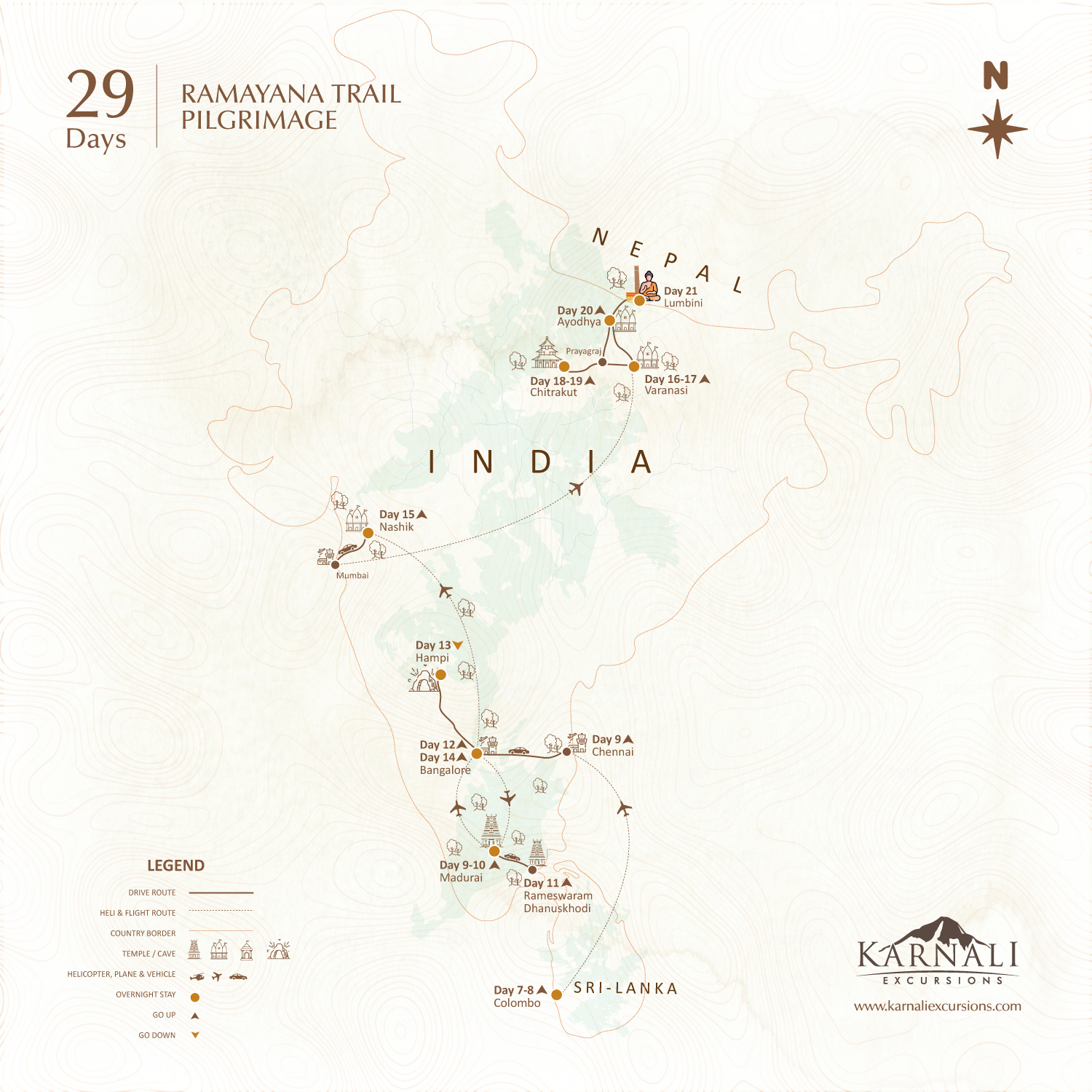
The epic Ramayana is the spiritual blueprint of the dharma that guides our way of life of every individual of the Bharat, Nepal and beyond. The epic represents the living memory of a our civilizational cultural past. Now, imagine stepping inside that story. Imagine standing on the very ground where Lord Rama walked, where Sita Mata offered her prayers, where Hanuman’s mighty leap first touched the soil of Lanka. Imagine bathing in the same river where the exiled prince of Ayodhya rested, praying under the same banyan trees that sheltered the divine couple during their years of Vanavasa. This is not imagination. This is the “Ramayana Circuit Tirtha Yatra”, a meticulously designed, proper aligned with the Ramayana story, pilgrimage that systematically traverses the living sacred landscapes across Sri Lanka, India, and Nepal, following the divine footsteps of Lord Ram, Sita, and their entourage. This transnational journey immerses pilgrims in the timeless wisdom of the Ramayana and Bhagavat Purana, offering a genuine path to moksha and self-realization.
Karnali Excursions, with three decades of expertise in organizing the divine pilgrimages, invites you, all Sanatani followers, to return to your sacred ancestral landscape of living dharma, the hallowed terrain where myth, memory, and pilgrimage converge, to reconnect with your cultural past, and to become a fellow pilgrim walking the eternal path of Maryada Purushottam Lord Rama. This pilgrimage is an invitation to pay homage to the sacred landscapes not through books or screens, but through your own footsteps, making it homecoming rather than vacation.
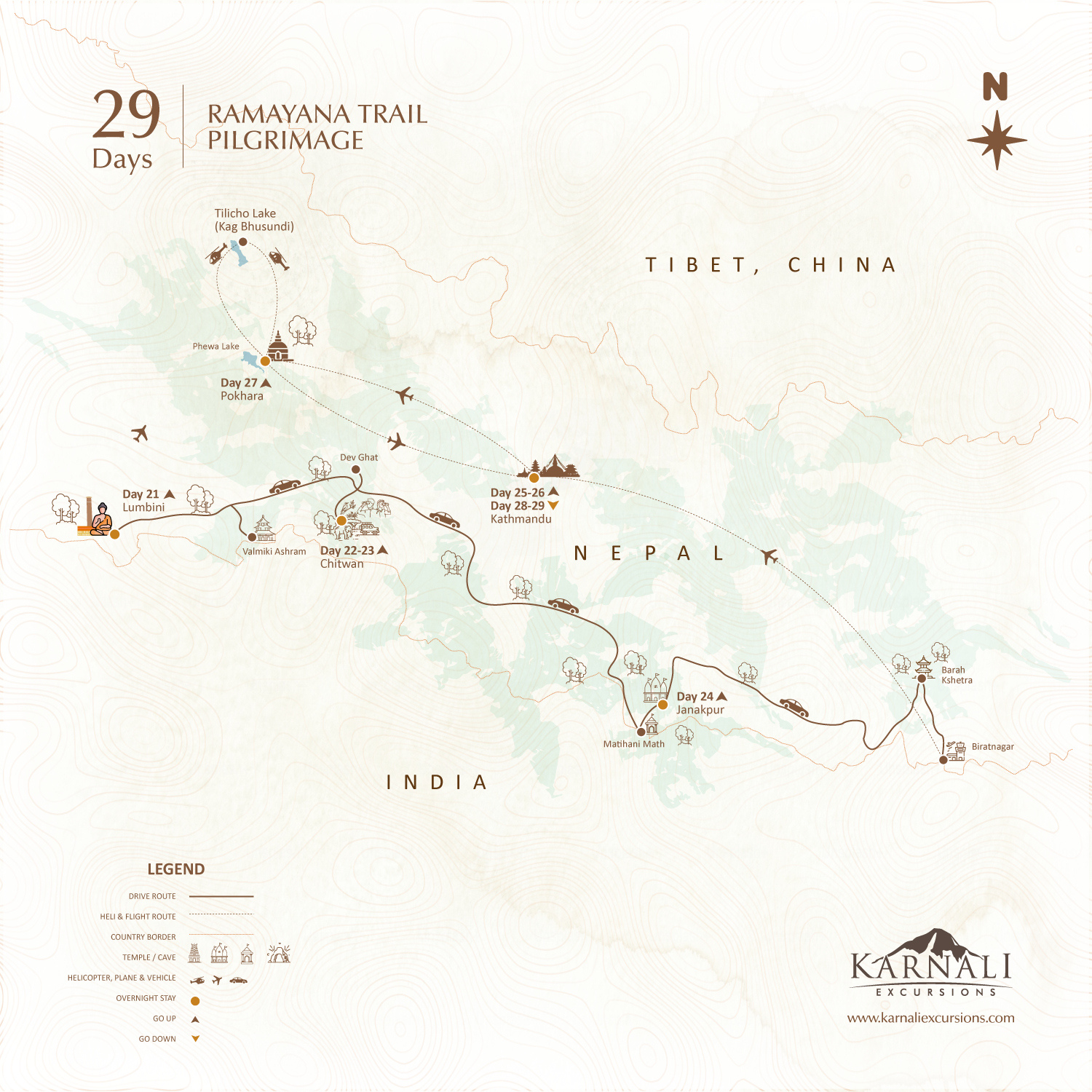
The Ramayana is not just a story that happened long ago. It is a geography that still breathes. The rivers still flow. The hills still stand. The temples still echo with the prayers of millions who have walked this path before you. You will travel across all the sacred landscapes of Sri Lanka, India, and Nepal for almost a month following the sacred spots of the Ramayana.. The journey opens in Sri Lanka, where the spiritual battle of Lanka stands as an eternal testament to the triumph of dharma over adharma. Here, you will witness the grandeur of Ravana’s devotion to Lord Shiva at Thiru Koneswaram Temple, stand in the Aśoka Vatika where Sita Mata was held in captivity, and visit the place where Hanuman first met her with Rama’s message of hope. Crossing the ocean back to India, you will journey through the heart of the Ramayana, immersing yourself in the spiritual and cultural heritage of Bharat: Rameswaram, where Lord Rama built the famous Rama Setu and installed the sacred Jyotirlinga; Hampi, the ancient kingdom of Kishkindha, where Rama met Sugriva and where Hanuman was born; Nashik’s Panchavati, where Sita was abducted from her forest hermitage; the tranquil forests of Chitrakoot, where the divine couple spent their exile years; Prayagraj’s Triveni Sangam, where Rama himself once bathed; Varanasi, where the eternal Ganga Aarti has continued uninterrupted for centuries; and finally Ayodhya, the birthplace of Lord Rama, the city of dharma itself. The trail then leads further into the unknown and uncharted, you will be among the first to chart this sacred territory, taking you to the energy-erupted places that Lord Rama loved, the very footsteps that the Suryavamshis traversed. The journey further unfolds into Nepal paying homage to Lord Buddha leading to Valmiki Ashram, the hermitage where the sage Valmiki composed the Ramayana, where Sita found refuge, and where Lava and Kusha were born. You will also explore the sacred confluence of Devghat Dham and travel to the sacred land of Mithila, the birthplace of Sita Mata, where the divine courtship of Maharshi Janaka unfolded. In Janakpur, you will stand in the very pavilion where Lord Rama and Sita Mata were married and see the fragment of Lord Shiva’s celestial bow that only Rama could string. Then the journey intersects at at Kathmandu, performing the Rudrabhisekha at Pashupatinath Temple, one of the holiest shrines of Lord Shiva. The journey takes you to the penultimate destination of the yatra Tilicho Lake (4,919 m), where the sage Kag Bhusundi is said to eternally recite the Ramayana to Lord Garuda. You will be among the very few pilgrims to ever reach this remote, sacred site where the story never ends but is told forever. Your pilgrimage finally culminates at Muktinath, where the sacred 108 Mukti Dhara liberates every pilgrim and offers moksha.
The Ramayana Yatra is a profound spiritual odyssey, an invitation to walk the path of righteousness, courage, and devotion in a disciplined way. While you traverse these sacred lands, each step resonates with the divine, bridging the material and the transcendent, guiding you toward the light of freedom. You will journey with others like yourself, Bharatiya origin seekers from all around the world, all longing to reconnect with their roots. Together, you will become a community of memory, devotion, and belonging. When you return home a living, embodied connection to the story that has defined your culture for thousands of years. The path is waiting. The divine footsteps are still fresh. The sacred lands are calling you home.
Group A (Starts from Colombo) Sri Lanka → India → Nepal


Group B (Joins in Madurai) India → Nepal
Journey Features
- Flight 1 (Kathmandu – Lhasa)
- Drive 1 (Lhasa – Shigatse – Tingri – Darchen)
- Trek (Kailash Parikrama)
- Drive 2 (Darchen – Puhrang)
- Flight 2 (Puhrang – Lhasa)
- Flight 3 (Lhasa – Kathmandu)
Trip Highlights
- Visiting the Divine Birthplaces:Pay homage at the sacred birthplaces of Lord Rama in Ayodhya, Sita Mata in Janakpur, Lord Hanuman on Anjanadri Hill in Hampi, Lava and Kusha at Valmiki Ashram in Chitravan, and Ravana in the ancient landscapes of Sri Lanka, completing all the sacred landscapes associated with the Ramayana epic.
- Complete Darshan of Bharat Varsha:Traverse the entire sacred geography of the Ramayana across three nations: Sri Lanka, India, and Nepal, experiencing the living heritage of the epic from the Sri Lankan island through the shores of Rameswaram to the trans-Himalayan cultural geography.
Sri Lanka: The Sacred Island of Dharma Yuddha
- Munneswaram Temple: Sacred temple site where Lord Rama performed purification rituals after the war, seeking atonement for the sin of slaying Ravana, a devout Brahmin.
- Manavari Temple: The sacred site where Lord Rama installed the Ramalingam in Sri Lanka, worshipping Lord Shiva as an act of dharma-rite.
- Thiru Konneswaram Temple: Ancient Shiva temple perched atop Swami Rock, where Ravana himself is believed to have offered passionate devotion to Lord Shiva; one of the Pancha (five) Ishwarams of Sri Lanka.
- Sigriya (Ravana’s Legendary Palace): The legendary rock fortress and palace complex associated with Ravana’s grandeur, offering panoramic views of the ancient capital.
- Ramboda: Scenic hill overlooking the southern Sri Lanka, where Hanuman is said to have rested during his search for Sita.
- Sita Amman Kovil Temple: The shrine marking the exact spot where Sita Mata was held captive, surrounded by lush forests and hilly landscape, located in Seetha Eliya near Nuwara Eliya, on the bank of the river where she used to bathe during her captivity in the Ashok Vatika.
- Ashok Vatika: The sacred garden within the premises of Hakgala Botanical Gardens where Hanuman first encountered Sita, where he handed over the Rin of Lord Ram and shared the whole story conveying the plight of Lord Ram and esteemed journey towards Sri Lanka upon his return to Kishkindha.
- Kataragama Temple; Ancient sacred complex dedicated to Lord Murukan (Skanda Kumar), where Hindu, Buddhist, and indigenous Vedda traditions converge in rare pilgrimage harmony.
- Kelaniya Temple (Vibhishana’s Coronation Site) and Kelaniya Mahaviharaya: The revered Buddhist temple where, according to tradition, Vibhishana was crowned king of Lanka after Ravana’s defeat, restoring the righteous rule in Sri Lanka. Kelaniya Mahaviharaya is an ancient Buddhist temple on the banks of the Kelani River, believed to have been blessed by Buddha during his third visit to Sri Lanka.
- Ussangoda (Ravana’s Airport): Unique red-earth landscape believed to be the mythical airport or landing strip of Ravana’s Pushpaka Vimana.
- Tooth Relic Temple in Kandy: UNESCO World Heritage site housing the sacred tooth relic of Lord Buddha that represents Sri Lankan Buddhist cultural heritage.
- Dambulla Cave Temple and Golden Temple: Magnificent UNESCO rock cave monastery with over 80 documented caves and stunning Buddhist murals spanning more than two thousand years.
India: The Heart of the Ramayana
Madurai & Rameswaram: The Sacred Southern Coast
- Meenakshi Amman Temple: Magnificent Dravidian masterpiece spanning 14 acres, dedicated to Goddess Meenakshi (Parvati) and Lord Sundareswarar (Shiva), featuring the legendary Thousand Pillar Hall with musical columns that produce distinct notes when struck.
- Ramanathaswamy Temple Rameswaram: One of the twelve sacred Jyotirlingas, renowned for the longest temple corridor in the world adorned with 1,212 intricately carved granite pillars, where Lord Rama installed the Shiva Lingam before the construction of the celestial Ram Setu bridge connecting Lanka.
- 22 Theerthams: Twenty-two sacred bathing tanks within the temple complex, each believed to possess unique purifying properties and tied to specific episodes from the Ramayana.
- Agni Theertham: The holy sea-facing bathing ghat where pilgrims purify themselves before entering the Ramanathaswamy Temple, facing the direction of the mythical Rama Setu.
- Kothandaramaswamy Temple: Serene temple at the edge of the sea, believed to mark the site where Vibhishana surrendered to Lord Rama before the great battle.
- Dhanushkodi: The impressively beautiful ‘End of the Bow’, where the Indian Ocean and Bay of Bengal meet, marking the point from which Lord Rama constructed the celestial Rama Setu bridge to Lanka.
- Panchamukhi Hanuman Temple: Unique shrine featuring Lord Hanuman in his five-faced form, Anjaneya (devotion), Narasimha (protection), Garuda (courage), Varaha (prosperity), and Hayagriva (wisdom).
Hampi (Kishkindha): The Vanara Kingdom
- Kishkindha Kingdom: The ancient Kishkindha kingdom where the chronicle of the Ramayana’s Kishkindha Kanda took place, where Lord Rama first met Hanuman and formed an alliance with Sugriva.
- Sugriva Cave: Natural rock formation where the exiled Vanara king Sugriva first met Lord Rama, forging the alliance that would lead to Sita’s rescue.
- Vali Cave (Valikote Cave): Mythical site near Anegundi, believed to be the place where Vali resided and fought the demon Mayavi. The cave overlooks the rich, rustic and mythical landscapes and the Tunga Bhadra River valley.
- Rishyamukha Hill: The tranquil hill where Hanuman first encountered Lord Rama and Lakshmana, recognizing their divinity and promising eternal service.
- Anjanadri Hill: The revered birthplace of Lord Hanuman, son of Vayu and Anjana, offering breathtaking panoramic views of the Tungabhadra River valley.
- Kodanda Rama Temple: Sacred riverside temple marking the spot where Lord Rama crowned Sugriva as king of Kishkindha restoring dharma.
- Virupaksha Temple: Ancient functioning Shiva temple with towering gopurams, intricately carved pillars, and a history of continuous worship spanning over a thousand years.
- Hemakuta Hill: Hill dotted with ancient shrines and monolithic structures, believed to be where Lord Shiva granted a divine boon to Goddess Parvati.
- Pampa Sarovar and Sabari Ashram: Sacred lake where Pampa Devi performed penance to win Lord Shiva, and Sabari Ashram/Cave where Shabari waited for Lord Rama and offered ber fruits are located near Anjanadri Hill.
- Hazara Ram Temple: A 15th century royal temple, built by Devaraya, renowned as an ‘epic in stone’ for its intricate sculpture panels narrating the entire Ramayana across its walls.
- Shree Vijaya Vitthala Temple: Architectural marvel of the Vijayanagara Empire, featuring the iconic stone chariot and fifty-six musical pillars that produce classical ragas when gently tinged.
- Historical Vijayanagara Kingdom: UNESCO World Heritage site spanning over 4,000 hectares, preserving the grandeur of the last great Hindu empire in South India.
Nashik: Panchavati Forest Hermitage
- Panchavati: Sacred forest hermitage named for its five ancient Banyan trees, where Lord Rama, Sita Mata, and Lakshmana resided during their exile, living in harmony with sages and nature.
- Sita Gufa: Subterranean cave where Sita Mata worshipped Lord Shiva during her forest exile, containing ancient idols of the divine trio and an old Shivlinga.
- Kala Ram Temple: Striking 18thcentury black stone temple dedicated to Lord Rama, with intricate carvings and a golden pinnacle symbolizing eternal divine presence.
- Gora Ram Temple: Serene white marble temple offering a contrasting ambiance of peace and purity, dedicated to the gentle aspects of Lord Rama.
- Trimbakeshwar Jyotirlinga Temple: One of the twelve sacred Jyotirlingas, distinctive for its three-faced lingam representing Brahma, Vishnu, and Shiva, and the source of the holy Godavari River.
- Godavari River bank: Sacred confluence where the Godavari River begins its journey, where pilgrims bathe to purify themselves and seek divine blessings, one of the four Kumbh sites of Bharat.
Varanasi & Prayagraj: Sanctuaries of Devotion & Liberation
- Kashi Vishwanath Temple: One of the twelve Jyotirlingas, the holiest Shiva shrine in Varanasi, where the golden temple pinnacle shines above the sacred lingam granting liberation (moksha) to sincere devotees.
- Shree Sankat Mochan Hanuman Temple: Holy shrine of Lord Hanuman, established by the poet-saint Goswami Tulsidas, composer of the Ramcharitmanas, where devotees seek removal of afflictions and obstacles.
- Ganga River Ghats: The celestial riverfront steps/ghats of Varanasi, where the nightly Ganga Aarti offers a mesmerizing spectacle of fire, sound, incense, and devotion that has continued uninterrupted for centuries.
- Prayagraj Sacred Sangam: The revered Triveni Sangam, holy confluence of the Ganga, Yamuna, and the mythical Saraswati rivers, considered the king of all pilgrimage sites (Tirtharaja).
- Maharshi Shree Bhardwaj Ashram: Ancient hermitage where Lord Rama, Sita, and Lakshmana rested during their exile, receiving guidance and blessings from the Maharshi Bharadvaja.
Chitrakoot: The Forest of Exile
- Mandakini River: The celestial stream brought to earth by the Tapobal (ascetic Power) of Sati Anusuya, where Lord Rama, Sita Mata, and Lakshmana bathed daily during their exile, its tranquil waters still flowing with divine resonance.
- Atri and Anusuya Ashram: Holy hermitage where Sita Mata received profound teachings on pativrata dharma (devotion and chastity) from Sati Anusuya.
- Kamadgiri Parikrama: Blissful five-kilometer circumambulation of the hill believed to be Lord Rama himself manifested as a sacred mound, cleansing sins and fulfilling sincere wishes.
- Bharat Milap: Revered site where Bharat, Rama’s devoted brother, met the exiled Lord to beg his return to Ayodhya, receiving only Rama’s sandals as a symbol of substitute kingship.
- Hanuman Dhara: Sacred natural spring cascading down the mountainside, believed to have been created by Lord Rama to cool and console Hanuman after the war.
- Sphatik Shila: Crystal-clear rock platform where Lord Rama and Sita Mata are believed to have sat together, enjoying the panoramic beauty of Chitrakoot’s forests, where Jayanta, Devraj Indra’s son, in the disguised form of a crow pecked Sita Mata’s feet.
- Gupta Godavari Cave: Twin caves with natural water streams flowing through them, where Lord Rama, Sita Mata and Lakshmana are said to have stayed during their forest dwelling.
- Bharat Koop: Ancient sacred well where Bharat is believed to have performed rituals while waiting for Rama’s return from exile.
Ayodhya: The Birthplace of Lord Ram
- Ram Lalla Temple: The newly constructed sacred birthplace of Lord Rama, an architectural marvel blending Nagara-style architectural grandeur with intricate carvings, housing the divine Ram Lalla statue.
- Kanak Bhavan: Resplendent golden temple gifted to Sita Mata by Queen Kaikeyi, adorned with exquisite golden idols of Lord Rama and Sita Mata.
- Shree Hanuman Gari Temple: Fortress-temple dedicated to Lord Hanuman as the eternal guardian of Ayodhya, reached by steep stairways leading to a sanctum where Lord Hanuman sits in eternal vigilance.
- Guptar Ghat: Sacred Sarayu River Ghat where Lord Rama and heavenly retinue is believed to have taken Jal Samadhi, completing their mortal manifestations.
- Sarayu River: The holy river flowing through Ayodhya that witnessed Lord Rama’s childhood and coronation, where pilgrims bathe to purify themselves.
- Ram Ghat and Laxman Ghat: Revered riverfront ghats named after the divine brothers, where evening aartis fill the air with devotional chanting and floating oil lamps.
Nepal: The Land of Sita, Valmiki, and Himalayan Recitation
Lumbini: The Birthplace of Lord Buddha
- Birthplace of Buddha: UNESCO World Heritage site marking the exact location where Queen Mayadevi gave birth to Prince Siddhartha, who would become the enlightened Buddha.
- Mayadevi Temple: Sacred sanctum enshrining the precise birth spot, featuring an ancient marker stone and bas-reliefs depicting the divine childbirth.
- Ashok Pillar: Standing stone pillar erected by Emperor Ashoka in 249 BCE, bearing inscriptions that confirm Lumbini as the birthplace of Lord Buddha.
Chitravan (Chitwan): Valmiki’s Hermitage
- Valmiki Ashram: The hallowed hermitage where Maharshi Valmiki composed the entire Ramayana, where Sita Mata found refuge, and where Lava and Kusha were born and trained.
- Triveni Dham: Sacred confluence of Narayani (Sapta Gandaki), Sona and Tamasa rivers, considered highly auspicious for ancestral rituals and spiritual cleansing.
- Gajendra Moksha Dham: Sacred site commemorating the legendary liberation of the elephant king Gajendra by Lord Vishnu, symbolizing divine protection of devotees.
- Devghat River Sangam: Holy confluence of the Sapta-Gandaki rivers, referred as Adi Prayag, blessed by the stay of Sita Mata during her exile, believed to grant profound spiritual purification.
- Sita Cave: Natural cave associated with Sita Mata’s meditation and spiritual practices during/before her refuge at Valmiki’s hermitage.
- Bashistha Cave: Ancient cave hermitage of Sage Vashistha, the royal guru of the Ikshvaku dynasty and spiritual guide to Lord Rama.
- Chitwan National Park: UNESCO World Heritage site offering jungle safaris through dense sal forests and grasslands, where pilgrims encounter elephants, rhinos, and tigers in their natural habitat.
Janakpur: The Kingdom of Mithila
- Janaki Mandir: Magnificent Rajput-Mughal style white marble temple built in 1911 CE, the divine abode of Sita Mata, adorned with intricate domes, carvings, and vibrant frescoes.
- Rajdevi Temple: Ancient temple dedicated to the royal goddess of the Mithila kingdom, worshipped by generations of Janak’s dynasty.
- Sankatmochan Temple: Sacred Hanuman shrine in Janakpur, where devotees seek the removal of afflictions and obstacles.
- Shree Ram Janaki Biwah Mandap: The exact ceremonial pavilion where Lord Rama and Sita Mata’s celestial wedding took place, beautifully decorated with sculpted shrines symbolizing the divine union.
- Dhanush Dham: Sacred site enshrining the remnant of Lord Shiva’s celestial bow, which only Lord Rama could string and break to win Sita Mata’s hand.
- Matihani: Holy village preserving the sacred soil used in Lord Rama and Sita Mata’s wedding rituals, considered highly auspicious for newlyweds and devotees.
Muktikshetra (Kali Gandaki Region): Liberation in Trans-Himalayas
- Muktinath Temple: One of the most ancient Vishnu temples in the trans-Himalayan region, where the sacred 108 Mukti Dhara (108 water spouts) pour holy water over devotees seeking liberation.
- Kali Gandaki River: The sacred river that flows through the deepest gorge in the world, source of the shaligrams, black fossil stones worshipped as manifestations of Lord Vishnu.
- Kag Bhusundi Lake (Tilicho Lake, Manang): One of the highest lakes in the world at 4,919 meters (16,138 feet), where the sage Kag Bhusundi, in the form of a crow, is said to eternally recite the complete Ramayana to Lord Garuda, a site so remote that only the most devoted pilgrims ever reach its pristine turquoise waters.
Kathmandu Valley: The Pashupata Kshetra
- Pashupatinath Temple: UNESCO World Heritage site dedicated to Lord Shiva as Pashupati (Lord of All Beings), where the evening aarti on the Bagmati River draws thousands of devotees seeking spiritual fulfillment.
- Guhyeshwari Shaktipeeth Temple: One of the sacred Shakti Peethas, revered as the site where the Guhyanga of Sati Devi fell.
- Budhanilkantha Jal Narayan Temple: Mesmerizing temple featuring a five-meter-long reclining Vishnu floating on the cosmic serpent Ananta in a tranquil water tank.
- Hanumandhoka Palace (Kathmandu): UNESCO monument of Kathmandu Durbar square with a complex named after the Hanuman idol at its entrance, where the living goddess Kumari resides and where ancient Newar architecture reaches its zenith.
- Doleshwar Mahadev Temple: Sacred Shiva temple revered as the Head of Kedarnath.


Detail Itinerary

About Karnali Excursions
Resources
-
-
 Essential Information
Essential Information for Ramayana Trail Pilgrimage Tour:
A. Must Bring Documents:
- Recent and Valid Passport:
-
- Ensure that your passport is up-to-date and valid for at least 6 months from your travel date.
- Passport-Size Color Photos:
-
- Carry passport-size color photographs (typically 4-6 photos) for any required documents, permits, or applications during the tour.
- Photocopies of Passport and OCI Card or Indian Visa:
-
- Bring photocopies of your passport along with your OCI card or Indian visa (if applicable) for easy reference.
- Cash-Less Travel and Medical Insurance Policy:
-
- A cash-less travel and medical insurance policy should be arranged prior to departure to ensure safety and coverage during the tour.
- Health Certificate:
-
- A health certificate from a certified medical professional (as required by the tour organizer) should be presented, confirming that you are fit for travel, especially for any high-altitude or physically demanding areas.
B. Hotel and Power-Related Matters:
- Basic Infrastructure:
In some areas, infrastructure may not be as developed as other more urbanized regions. Expect basic facilities, and it is important not to compare the accommodations to those of more developed destinations. - Water & Power Availability:
There may be occasional water shortages in some regions, and water supply could be provided only at certain times, typically in the morning and evening. - Power Outages:
Some hotels may not have generator facilities. In case of power failure, the hotels will provide candles for lighting.
C. Flight Details:
- Flight Information:Once you have booked your flights, please share your flight details with us immediately. This is crucial for the proper arrangement of your airport pick-up in Kathmandu.
- Last-Minute Changes:
If there are any last-minute changes to your flight details, notify us immediately by email. - Airport Pick-Up:
Upon arrival at Kathmandu, look for the Karnali Excursions signboard outside the airport to identify your pickup.
- Last-Minute Changes:
D. Passport and Visa-Related Issues:
- Visa Requirement:All foreign passport holders require a valid visa for India, Nepal, and Sri Lanka. You can obtain this visa by contacting the nearest Indian Embassy or Consulate in your home country.
- Indian Passport/OCI Card Holders:
Indian Passport holders or those with an OCI card do not require a visa for India, but they must travel with their valid passport and OCI card. - Passport Validity:
Ensure your passport is valid for at least 8 months beyond your arrival date in India.
- Indian Passport/OCI Card Holders:
E. Remaining Balance:
- The remaining balance for the tour must be paid in USD (US Dollars) or GBP (Sterling Pounds) in cash upon arrival in Kathmandu.
- Cheques:
Unfortunately, personal cheques are not accepted by Karnali Excursions.
F. Additional Funds:- Personal Use Funds:We recommend bringing an additional USD 1500 (or GBP 950) per person for personal expenses during the Yatra. This will cover expenses like:
- Phone calls
- Mineral water
- Souvenirs
- Tips, etc.
G. Travel Insurance – Mandatory:
- Insurance Requirement:All participants must carry cash-less travel insurance that covers the following:
- Emergency rescue(both by air and ground)
- Repatriation
- Tour cancellation
- Medical expenses
- Documentation:Please bringtwo hard copies of the insurance policy, which must contain the policy number and emergency contact details.
-
-
- One copy should be handed over to our representative upon arrival in Delhi.
- Keep the second copy with you for your reference during the journey.
-
H. Preparation, Health, and Medical Related:
- General Health:Although most of the journey will be by vehicle, participants are expected to be in relatively good health. If you have any chronic health conditions, please consult your doctor before departing for India.
- Medical Facilities:Medical facilities will be available throughout the journey, but it’s essential to take personal health precautions.
- Health Preparation:We recommend the following:
- Exercise regularly and prepare by walking or hiking.
- Develop a habit of drinking at least three liters of water daily. This will help maintain your health and energy levels during the Yatra.
Karnali Excursions (P) Ltd. will provide a first-aid medical kit for the journey.
K. Karnali Staff:
- Experienced Team:Karnali Excursions employs only experienced professional staff who have successfully led excursions across India, Tibet, and the Nepal Himalayas.
- Guides:Each trip is staffed with an experienced guide who is proficient in English and Hindi, ensuring that communication is smooth and your journey is comfortable and informative.
- Commitment to Quality Service:Karnali Excursions is committed to providing the best and most reliable service, making the Yatra an unforgettable experience.
J. Risk and Liabilities:
- Efforts to Ensure Smooth Journey:While Karnali Excursions will make every effort to ensure a smooth and pleasant journey, there are factors beyond our control that may affect the itinerary.
- Unavoidable Circumstances:Please be aware that Karnali Excursions is not liable for any changes in the itinerary caused by unavoidable circumstances, including but not limited to:
- Government restrictions(including changes in local laws or regulations)
- Landslides, road blockades, or flooding
- Snowfall, political disturbances, flight cancellations
- Illnesses or accidents
- Additional Costs:Any additional costs incurred due to such unforeseen circumstances must be borne by theYatris(participants).
K. Yatra Logistics:
- Airport Pickup and Drop-off:You will be picked up from the airport on your arrival and dropped off at the end of the Yatra. To ensure smooth arrangements, please provide yourflight details well in advance.
- Duffle Bag and Personal Backpack:Every Yatri will receive areasonably sized duffle bag for the duration of the Yatra. This will be provided to you on the evening of your arrival day. In addition, each Yatri should bring a personal backpack/rucksack for carrying valuable personal items and other handy supplies. Please transfer your necessary travel items into the backpack from your main suitcase and make sure to remember your duffle bag number.
- Baggage Storage:Your normalbaggage and suitcase will be safely stored at the hotel in Delhi or another designated location while you are on the Yatra.
- Snacks and Supplies:Ensure you pack somesnacks and essential supplies in your backpack as your duffle bag might be traveling separately with a support vehicle.
- Adapters for Electronics:If you plan to charge any electronic devices during the Yatra,bring an adapter for 220-240 volts. This is necessary for charging your gadgets.
- Wi-Fi and Internet Connectivity:Wi-Fi andInternet connections are available throughout most of the Yatra. You can buy local SIM cards at the airports in India, Nepal, or Sri Lanka. If you prefer to use your home-based phone, please ensure that roaming is activated for India, Nepal, and Sri Lanka.
L. Important Preparation Tips for a Successful and Memorable Yatra:
- Physical Preparation:Consider incorporatinghiking and breathing exercises into your routine before the Yatra. This will help improve your stamina and overall well-being for the journey.
- Stay Hydrated:Make it a habit todrink at least 3 liters of water Staying hydrated is crucial, especially when traveling through diverse terrains and climates.
Mental and Physical Readiness:
This pilgrimage is a memorable journey that requires both mental focus and physical health. Preparing in advance will ensure you remain energized, healthy, and ready for a truly rewarding experience. -
 Trip Preparation Guide
Trip Preparation Guide
Ramayana Trail Pilgrimage
(Journey to India, Sri Lanka & Nepal)Curated by Karnali Excursions
Welcome to the Ramayana Trail Tirtha Yatra
The Ramayana Trail Pilgrimage is a transnational sacred journey retracing the divine footsteps of Lord Rama and Sita Mata across Sri Lanka, India, and Nepal. More than a physical expedition, this yatra is a disciplined spiritual journey, uniting scripture, geography, devotion, and lived tradition. From Lanka’s Ashok Vatika to Ayodhya, Janakpur, Valmiki Ashram, Kag Bhusundi Lake, and Pashupatinath, pilgrims walk the living landscape of the Ramayana.
This guide equips pilgrims with essential visa, health, cultural, and logistical preparation to ensure a smooth, meaningful, and reverent journey.
1. Visa Information (Multi-Country Pilgrimage)
A. India – Tourist Visa
Most foreign nationals require a visa to enter India, except citizens of a few neighboring countries.
Tourist Visa Options:
- e-Tourist Visa (e-Visa) – Most convenient for short-term travel
- Regular Tourist Visa – Issued through Indian embassies or consulates
Recommended: Apply for the e-Visa for easier processing and online convenience.
e-Tourist Visa (India)
You can obtain an Indian visa through the nearest Indian Embassy or Consulate, or by applying online for an e-Visa prior to travel. Visa-on-arrival is not available for most nationalities entering India.
Official Indian Visa Portal (e-Visa):
https://indianvisaonline.gov.in- Validity: 30 days, 1 year, or 5 years depending on type
- Entry Points: Airports and selected land borders
- Processing Time: 3–5 working days
- Required Documents:
- Passport valid for at least 6 months
- Recent passport-size photograph (digital)
- Passport bio-data page (scanned)
- Travel itinerary
Note: Travelers entering India via Nepal (common on joint Nepal–India pilgrimages) should confirm land border entry acceptance for their e-Visa, please check the eligibility for your nationality.
Karnali Excursions provides guidance, but visa applications are the responsibility of travelers.
B. Sri Lanka – ETA (Electronic Travel Authorization)
- Required for most nationalities
- Official ETA Website: https://www.eta.gov.lk
- Validity: 30 days (extendable)
- Processing Time: 24–72 hours
- Requirements:
- Passport valid for 6+ months
- Return/onward ticket
- Accommodation details
C. Welcome to Nepal
Nepal is a land of extraordinary diversity, where sacred heritage sites, subtropical forests, wetlands, grasslands, and Himalayan foothills coexist within a compact geographical space. Karnali Excursions designs nature and culture itineraries that are immersive, ethical, and thoughtfully paced, allowing travelers to experience Nepal’s wildlife, spiritual landmarks, and living traditions with comfort and insight.
This guide provides essential pre-departure and on-arrival information to help you prepare for a smooth, safe, and enriching journey.
a. Nepal Visa Information
Most international travelers can obtain a Tourist Visa on Arrival at Tribhuvan International Airport, Kathmandu.
Visa Requirements- Passport valid for at least 6 months
- At least one blank page
- Passport-size photograph
- Visa fee (USD cash preferred)
Visa Options:
- 15 Days
- 30 Days
- 90 Days
Travelers may also apply online in advance through Nepal’s official immigration portal to speed up airport procedures. Entry regulations may change, so we advise checking official government updates shortly before departure.
You can obtain this from your nearest Nepal Embassy or Consulate, or upon arrival at Kathmandu Airport. For more details, visit Nepal Immigration.
- Department of Immigration, Government of Nepal – main portal for visa information & online services: https://www.immigration.gov.np
- Online Visa Application Portal (official): https://nepaliport.immigration.gov.np (used for pre-arrival visa forms like tourist visa form)
b. Entry & Arrival in Nepal
- Arrival airport: Tribhuvan International Airport (KTM)
- Karnali Excursions representatives will meet guests for pre-arranged airport transfers
- Most tours begin in Kathmandu Valley, unless otherwise specified
2. Health & Travel Insurance (Mandatory)
Your insurance must cover:
- Medical emergencies & hospitalization
- Emergency evacuation (air/heli)
- Trip interruption/cancellation
- Pilgrimage-specific risks (long drives, river confluences, altitude)
Carry digital and printed copies at all times.
3. Physical Fitness & Yatra Discipline
- Tour Grading: Moderate
- Activities include:
- Temple darshan & parikrama
- Heritage walks (3–6 km/day)
- River confluences & sacred dips
- Hill walks (Anjanadri, Chitrakut) and Kag Bhusundi Lake (Heli-assisted)
- Preparation Tips:
- Begin light walking practice before arrival
- Comfortable footwear is essential
- Observe discipline, punctuality, and silence at sacred sites
4. Accommodation Standards
- Best Available Hotels (as per region)
- Comfortable pilgrim-friendly stays
- Twin-sharing basis (single supplement on request)
- Spiritual locations prioritized over luxury
5. Transportation & Journey Flow
- International & domestic flights
- Private air-conditioned vehicles
- Mountain and rural road travel
- Heli-flight (Kag Bhusundi Lake)
- Travel times may vary, flexibility is part of pilgrimage practice
6. Food & Dietary Observance
- Vegetarian meals widely available
- Satvik food emphasized during pilgrimage
- Jain, vegan, and special diets on prior request
- Drink only bottled or purified water
7. Climate & Best Travel Window
- Sri Lanka: Warm & humid (light cottons)
- India (South & North): Variable—layers required
- Nepal (Himalayan regions): Cool to cold—warm clothing essential
- Best overall months: October–March
8. Packing Essentials
- Modest temple attire
- Comfortable walking shoes
- Shawl/light jacket
- Personal medication & first-aid kit
- Sun protection
- Power bank & chargers
- Small daypack
- Sacred texts or japa mala (chanting beads) (optional)
9. Cultural Etiquette & Pilgrimage Conduct
- Dress modestly at temples
- Remove shoes before entering shrines
- Follow priest and guide instructions
- Avoid loud conversation & photography during rituals
- Use respectful greetings: “Namaste” / “Pranam”
10. Safety & Health
- Avoid raw water and street ice
- Use insect repellent in forest and river regions
- Maintain hydration
- Inform guides of any discomfort immediately
- Karnali staff trained in emergency response
11. Currency & Practicalities
- India: INR (Indian Rupees)
- Sri Lanka: LKR
- Nepal: NPR (Nepalese Rupees)
- ATMs available in cities
- Carry cash for temples & rural areas
- Local SIM cards available (passport required)
12. Responsible & Dharmic Travel
- Respect sacred landscapes
- Do not litter or disturb rituals
- Support local communities & temple economies
- Ethical photography only
- Walk gently—this is tirtha, not tourism
13. High-Altitude & Special Pilgrimage Notes
- Kag Bhusundi Lake (Tilicho Lake) includes heli support
- Follow strict guide instructions
- Avoid alcohol and heavy meals before ascent
- Acclimatization days included where required
14. Included Pilgrimage Itineraries
- Ramayana Trail Pilgrimage: Sri Lanka-India-Nepal, includes guided support, cultural briefings, and safety protocols.
15. Final Guidance for Pilgrims
- Prepare physically, mentally, and spiritually
- Carry all documents securely
- Trust the rhythm of the yatra
- Walk with humility, devotion, and discipline
Karnali Excursions is honored to guide you on this sacred Ramayana Trail,
where geography becomes scripture, and the journey itself becomes liberation. -
 Recommended Readings
Recommended Readings
01.India THE ROUGH GUIDE03.Footprint India02.India: A Travel Survival Kit
-
 Fixed Departures Dates
Fixed Departure Dates
S.no Bharat Yatra Arrival Departure 1 Ramayana Trail 20th Feb Starting From Srilanka Ending Kathmandu
Vaishali is a holistic wellbeing expert with over 17 years of experience guiding people toward clarity, inner healing, and personal transformation with clarity & purpose, across the Middle East and India. Her work weaves together sound healing, breathwork, Yoga-meditation, CST and sacred retreat experiences grounded in the belief that ancient wisdom and modern wellbeing are not separate paths.
Vaishali has been invited to speak at Forbes Middle East’s Healthcare Summit, Forbes Middle East’s Wellness Summit, and has presented at India’s Scientific Spirituality Conference. She has been honoured with the Splash Heart of Gold Award for her contribution to society and recognised by the Government of Fujairah for her role in the Fujairah Meditates for Peace initiative. With these experiences and many more, Vaishali brings a grounded sense of depth, sincerity, and credibility to every space she holds.

The mountains have a way of returning you to yourself.
This retreat is an invitation, to pause, go inward, and reconnect with what matters.
Ready to make this journey your own?
-
 Budhanilkanta 44600, Nepal
 -
 +977 9851035496
 -
 Karnaliexcursions@gmail.com
 Inqurie About Trip