

Kailash–Manasarovar Yatra
The Kailash–Manasarovar Yatra occupies a singular place in the spiritual geography of South and Central Asia. Revered across Hindu, Buddhist, Jain, and Bon traditions, Mount Kailash and its adjoining Lake Manasarovar constitute a liminal space where geography and cosmology converge. Pilgrims undertake this arduous journey not merely to traverse the physical terrain but to engage with a landscape that is at once sacred, historical, and cosmological—a living repository of spiritual and cultural memory. The 2025 Yatra, led by Hira Prasad Dhamala of Karnali Excursions, offered an exemplary lens through which to observe the enduring significance of this pilgrimage in contemporary contexts, while simultaneously engaging with the rich historical and cultural layers embedded in the terrain.
The Route and Its Cultural Significance
Beginning in Kathmandu, the journey passes through the verdant valleys of Nepal before entering Tibet at Kyirong, a historically significant corridor linking Nepal and Tibet. At an elevation of approximately 2,700 meters, Kyirong has long served as a spiritual and cultural bridge, sustaining monasteries like Tshamdrag Gompa, Rongshar Monastery, and Pakpa Lhakhang, which historically preserved Indian Buddhist teachings transmitted by masters such as Śāntarakṣita, Atisha, and Nāropa. The town is emblematic of the interweaving of spiritual and geographic corridors; as the 5th Dalai Lama noted, “In Kyirong, the gods walk gently, and the sound of Dharma echoes through its woods and cliffs.” These words resonate profoundly for the contemporary pilgrim, emphasizing that the journey is simultaneously outward and inward.
From Kyirong, travelers progress to Gungthang, a historical kingdom of western Tibet, significant for its role in the transmission of Buddhist knowledge from India. Gungthang’s monasteries and settlements, though remote, reflect a nuanced interconnection between political history, cultural identity, and spiritual practice. The route also passes the birthplace of Jetsün Milarepa in Kya Ngatsa, whose life and songs articulate the transformation of personal suffering into enlightenment. Encountering Milarepa’s homeland invites reflection on how geography itself becomes a mnemonic device for spiritual and ethical teachings, as the arid landscapes mirror the austerity of his early life and the profound discipline of his path.
Manasarovar: Cosmology and Contemplation
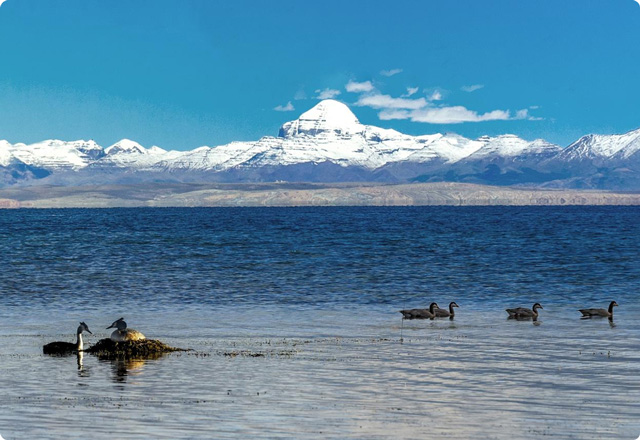
The Lake Manasarovar, lying at the foot of Mount Kailash, is both a physical and symbolic centerpiece of the pilgrimage. Hindu traditions regard it as the lake of Brahma, while Buddhist narratives interpret it as the mirror of purity, reflecting the awakened mind. Its pristine waters, fed by glaciers and alpine streams, embody ecological and cosmological significance, serving as the source for rivers that nourish much of South and Central Asia. Observing pilgrims perform ritual bathing and pitri tarpana—ancestral offerings—reveals the complex entanglement of bodily practice, spiritual purification, and ethical remembrance that defines the Yatra. The lake becomes not only a site of devotion but also a space of reflective engagement, prompting the pilgrim to situate themselves within broader cycles of nature, history, and cosmology.
The Circumambulation: Parikrama as Embodied Practice
The Kora—circumambulation of Kailash—represents the most physically demanding and spiritually resonant aspect of the Yatra. The trek begins at Yam Dwar (Tharboche) and proceeds over high passes, including the Dolma-La Pass(5,630 meters), circumnavigating a mountain that embodies the divine axis mundi in multiple religious traditions. For Hindus, it represents the cosmic mountain of Shiva; for Buddhists, it is the mandala of sacred geography; for Bon practitioners, it is the site of primordial spiritual activity; for Jain pilgrims, it is associated with the enlightenment of Rishab Dev.
Walking the Kora is an exercise in mindfulness, corporeal devotion, and cosmological literacy. Pilgrims encounter prayer flags, chortens, and monastic settlements, each narrating layers of historical, religious, and cultural meaning. The inner parikrama—encircling sites such as Astapada and Nandi—offers opportunities for meditation, prostration, and reflection, transforming the landscape into a living text that communicates spiritual truths. Observing local practitioners, often engaged in tshag (full-body prostration), underscores the embodied dimension of the pilgrimage: devotion is expressed kinetically as well as cognitively.
Intersections of Nature and Culture
The Yatra highlights the inseparability of the natural and the cultural in Tibetan landscapes. The glacial rivers originating from the slopes of Kailash—Karnali, Sutlej, Indus, and Brahmaputra—demonstrate how sacred geography and ecological significance intersect. Flora, fauna, and pastoral livelihoods—yak herding, nomadic settlements—offer insight into human adaptation in extreme environments while revealing culturally codified forms of environmental engagement. The pilgrim’s experience thus becomes simultaneously ecological, cultural, and spiritual; the landscape functions as both a material reality and a metaphoric canvas upon which religious and historical narratives are inscribed.
Reflections on Modern Pilgrimage
The 2025 Yatra exemplifies the continuity and transformation of pilgrimage in contemporary times. Organized tours like those provided by Karnali Excursions ensure safety, logistical support, and cultural interpretation, enabling diverse participants—from scholars to diaspora communities—to undertake the journey. Yet, the spiritual integrity of the pilgrimage is preserved: each step, ritual, and encounter maintains continuity with centuries-old practices. Moreover, the Yatra provides opportunities for intercultural dialogue; Indian pilgrims living across the globe, Tibetan monastic communities, and local nomads collectively contribute to a lived, intergenerational spiritual ecosystem.
The journey’s narrative structure—Kathmandu to Kyirong, Saga, Paryang, Manasarovar, and Darchen, followed by the Kora—mirrors traditional pilgrimage patterns while accommodating the exigencies of modern travel. This hybrid structure demonstrates the dynamic nature of spiritual tourism, which balances historical fidelity, religious devotion, and experiential accessibility.
Conclusion: The Transformative Geography of Kailash-Manasarovar Mandala
The Kailash–Manasarovar Yatra is, at its essence, a journey into the interstices of history, culture, and consciousness. Each site—Kyirong, Gungthang, Milarepa’s birthplace, Manasarovar, and the circumambulation path—functions as a text of layered meanings, inviting reflection on the human, ecological, and divine. Pilgrims return transformed, carrying memories, insights, and spiritual energy that resonate long after the journey concludes.
As a cultural historian and practitioner, one observes that the Yatra embodies the intersection of lived religion, sacred geography, and ritual practice. The mountain itself, immutable yet interactive, continues to teach lessons of humility, patience, and devotion. The pilgrims, in response, enact centuries of spiritual heritage, ensuring that Mount Kailash and Lake Manasarovar remain not merely physical landmarks but enduring symbols of human aspiration toward the sacred.
In the contemporary global context, this pilgrimage also fosters cultural continuity and cross-generational transmission. The sacred landscape of Tibet, despite geopolitical boundaries and modern infrastructural interventions, remains an active site of devotion and knowledge production. Through careful engagement—ritual, walking, observation, and reflection—pilgrims enact a dialogue with history, nature, and divinity, illustrating the enduring power of pilgrimage to cultivate insight, resilience, and spiritual transformation.
The Kailash–Manasarovar Yatra is, therefore, more than travel; it is a profound encounter with the sacred, an embodied lesson in cultural memory, and a living testament to the enduring interplay of human devotion and cosmic order. It remains one of the most compelling examples of how geography, culture, and spirituality converge to create transformative human experiences—a pilgrimage not just of place, but of consciousness.